The world is looking for Christians. Let them know when any show up.
The year is 1777. It is late December. You are at a place called Valley Forge, Pennsylvania. You are in the Continental Army led by General George Washington during the American Revolutionary War. Looking over a barren plateau, a day’s march from Philadelphia, you only have a mental picture of what will soon become reality. You have to build your living quarters, mess hall, command center, and supply huts before you can occupy them. You’re cold. You’re tired. You are hungry and your clothes were nothing more than glorified rags. Still, having a spark of fighting spirit and determination, you muster all the strength you have and put yourself to the task of building your encampment knowing that just 18 miles to the southeast there lies the enemy. The city that was stolen by the British that must be taken back.
As far as the building project goes, the officers formed the men into construction squads and instructed them to build cabins according to a 14-foot by 16-foot model. The army placed the 2,000-odd huts in parallel lines, and according to one officer, the camp “had the appearance of a little city” when viewed from a distance. Most agreed that their log accommodations were “tolerably comfortable.”
Being a professional soldier in the Army took a lot of training as well. My career started with Basic Training at Fort Leonard Wood, MO, and progressed to Advanced Training at Fort Knox, KY. I was in a total of 8 years, and even after I graduated from my advanced training to be proficient in repairing tanks, I still had to train at my permanent duty station in Kirchgons, Germany. As we prepared for conflict in the Persian Gulf, we had to learn a little Arabic, enemy tactics and what he used as weapons, and we trained for desert fighting since most of us have never been in the desert. We were given playing cards with pictures of enemy vehicles on them so we could memorize them and recognize them when we saw one. Yes, terrain and tactics may change, but our training proved itself in victory 35 years ago when we liberated Kuwait.
One of the weaknesses of the Continental Army of 1777, as told to us by General George Washington himself, was that too many commands were heard during campaigns that confused the militia. It is said that many a battle may have been won had it not been for someone to randomly yell, “RETREAT,” and the men would scatter. Can you see how that would disorient the soldiers? Valley Forge would change all of that. A German by the name of Baron Heinrich Wilhelm von Steuben was put in charge of drills and marksmanship. His tactics are still in use in today’s military. He taught them how to march in ranks. How to turn and pinwheel and advance or retreat on command. Besides the sounding of “Charge” and “Retreat,” the military still uses bugle calls beginning early in the morning for waking up with ”First Call,” for the raising of the flag with the playing of “Reveille,” the morning and afternoon mess, the lowering of the flag with “Retreat” and “To the Colors,” and for lights out by the playing of “Taps.”
Why does the training never stop? The enemy is always changing his tactics, his frontal assaults, and the use of his arsenal. Discipline builds confidence. Knowing your equipment and how to use it is vital. The gas chamber helped us understand how a protective mask keeps out dangerous chemicals. We learned about military operations, but most importantly, we learned about ourselves. When our heads were spinning with questions, our confidence made possible through discipline and training, kept up moving forward.
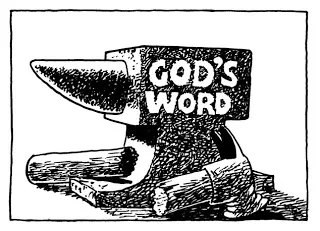
As Christian soldiers, we have an arsenal as well—the Full Armor of God (Ephesians 6:13-18). The greatest offensive weapon ever entrusted to mankind is the Sword of the Spirit, or the Word of God. Added to that is the Shield of Faith that can deflect any projectile the enemy has to throw at us. Don’t let your guard down. We can’t let our shields to be shattered. King Ahab found out a weakness in his armor when a random arrow found its mark through a crack and took his life (1 Kings 22:34-36).
Proper use of God’s Word comes from training and practice. Training is staged at our church gatherings small groups. Just like listening to a coach, or a drill instructor, the application of what we learn during our training in practice can determine our success or failure in real life combat. We have to remember all the battle plans, trust in our authority, and how and where we have to go when an attack is launched against our position. When given orders, we have to know the Authority of the one who has charging us with those orders and when the trumpet blows at the order of the Commander, what to do. “For if the bugle produces an indistinct sound, who will prepare himself for battle?” (1 Corinthians 14:8).
Following God’s plans for the church and for families is very important to our success here on earth. When we memorize Scripture, or parts of it, we have embedded God’s word in us. I had two professors in seminary who challenged themselves with memorizing the entire New Testament. I personally knew these men: Dr. Lewis Foster, Dr. Wilke Winter, and a preacher friend named brother Ed Bousman. I know two of them succeeded. One of them was asked to speak in a country in which is was forbidden to be seen with a bible—Albania in the 1980’s. During that time, Christian leaders were being executed for their faith. Dr. Lewis Foster, who also helped translate Luke and Acts in the NIV, traveled to Albania and preached the bible from memory.
We may not always have a Bible near us. Sometimes we need an answer to a situation immediately. 1 Peter 3:15 says, “Always be ready to give a defense to everyone who asks you to give an account for the hope that is within you with gentleness and respect.” When we have the Word of God in our minds and on our hearts, we have God’s answer to the situation. This way, we will know what God would want us to do. The Bible says to hide the Word of God in our hearts so that we will not sin against God. Knowing the Bible allows us to follow Jesus and to be sensitive to His leading.
Psalm 119:9-16 is one of my favorite Scriptures from Psalms. Imagine us praying to God to know more of His ways than to learn how to avoid them.
The takeaway for today’s message, discipline and training made the difference in the Continental Army. It increased their confidence, courage, and proficiency, which gave them greater hope, faith, and victory.
A quote attributed to Baron von Steuben as he entered the emcampment at Valley Forge was, “I’m here to train soldiers. Let me know when any get here.” May it never be that someone should walk in among us and say, “I’m looking for faithful Christians. Can you please tell me where I can find some.” What does the Christian life look like? God gives us all we need to serve Him: mind, eyes, mouth, hands/arms, feet/legs. We’ve been using them wrongly for too long. Let go and let God show you how to use them rightly.
Very early in the morning, while it was still dark, Jesus got up, left His house and went off to a solitary place, where He prayed. (Mark 1:35)